
Designing the Diablyst Community - A Space for Questions, Support, and Shared Experience
#diablystPublished: 01 Sep, 2025
Designing the Diablyst Community 🤝
Alongside the website and blog, we’ve been working on another core surface of Diablyst: the Community / Discussions section. This space is designed for people who live with diabetes, care for someone with diabetes, or simply want to help others by sharing knowledge and experience. Diabetes is not just a medical condition—it is a daily, lifelong context. Questions don’t only come from lab reports or prescriptions; they come from meals, travel, stress, habits, celebrations, and uncertainty. The community section exists to capture those real questions and create space for real conversations 💬.
This update covers the intent behind the community feature, how we approached the design, and why engagement—not noise—was the primary goal.
Why Community Matters in Diabetes Care ❤️
Most diabetes-related platforms focus on tracking, metrics, or static education. Those are important, but they don’t replace human context. People want to know how others handle similar situations. They want reassurance, perspective, and sometimes simply to be heard.The Diablyst community is built around that understanding. It is not meant to be a generic forum or social feed. Instead, it is a topic-driven discussion space where questions and answers are the main unit of value. At a high level, the community is designed to:
- Help people ask real, everyday questions without friction
- Encourage experienced members to support others 🧠
- Surface high-quality discussions instead of endless scrolling
- Create engagement that feels meaningful, not performative
This section is about shared learning, not popularity.
A Familiar but 🧭 Focused Layout
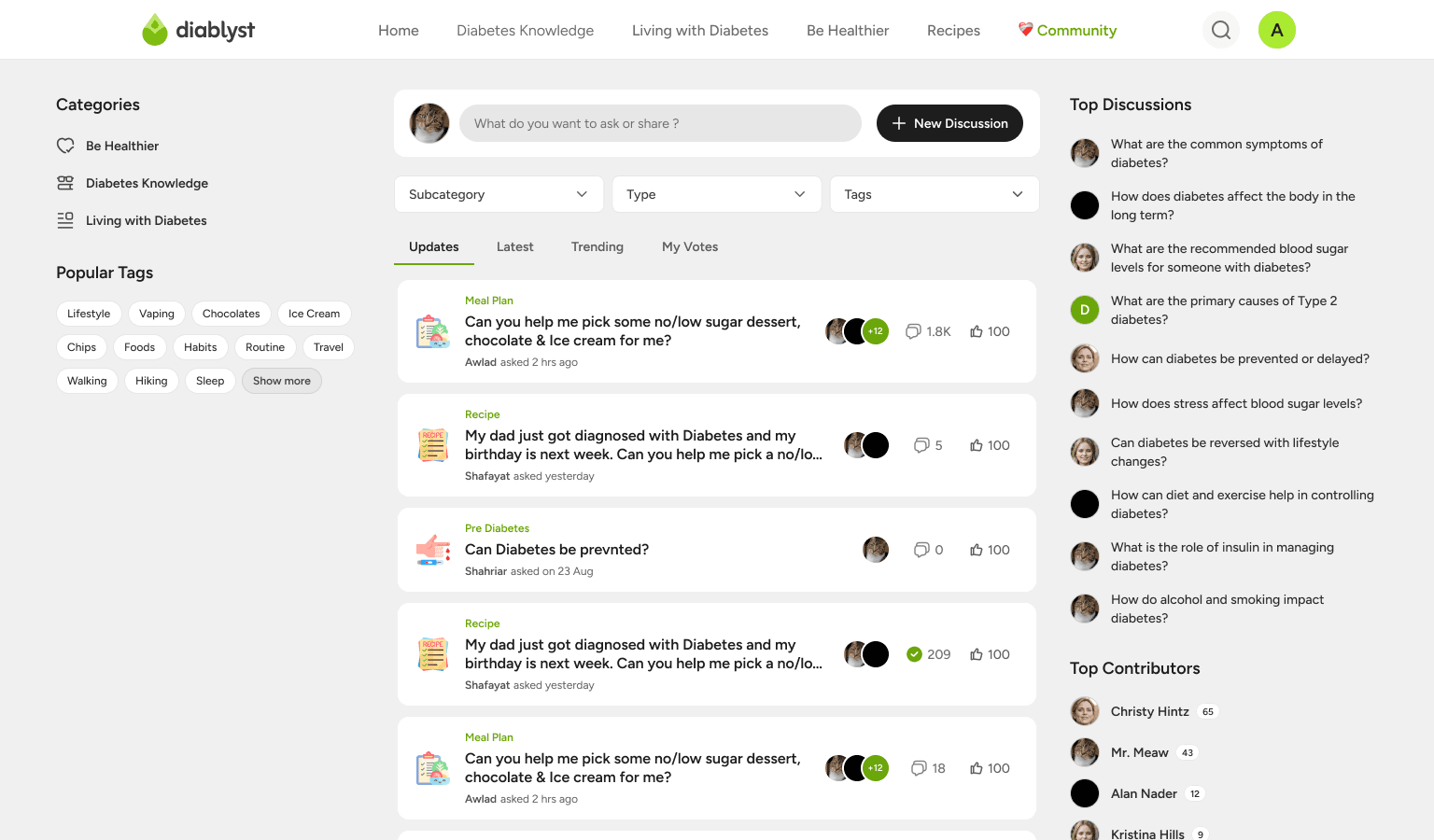
The first design draft intentionally follows a layout that feels familiar to anyone who has used modern discussion platforms. Familiarity reduces learning time and allows users to focus on content rather than interface.
The screen is structured into clear zones: categories on the left, discussions in the center, and contextual insights on the right. This layout supports scanning while still allowing depth. What matters most is that users can quickly understand:
- What topics are being discussed
- Which discussions are active or valuable
- Where they can contribute or learn
Nothing is hidden behind unnecessary interactions.
Categories That Reflect Real Life, Not 🩺 Medical Silos
One of the earliest decisions was how to structure categories. Instead of creating overly clinical or academic groupings, we aligned categories with how people actually think about their condition.
In the current draft, categories such as Diabetes Knowledge, Living with Diabetes, and Be Healthier anchor the experience. These are broad enough to be inclusive but specific enough to guide discussion. This approach helps in two ways:
- New users don’t feel intimidated by medical terminology
- Discussions naturally stay relevant and contextual
Over time, these categories can evolve, but the guiding principle remains the same: human-first organization.
✍️ Asking a Question Should Feel Easy
At the heart of the community is the question prompt: “What do you want to ask or share?”
This is intentionally simple. There is no pressure to format perfectly or write long explanations. The design lowers the barrier to participation so that someone with a quick doubt—or a moment of concern—can ask without overthinking. Once a discussion is created, users can add subcategories, types, and tags to give context. This keeps the initial action lightweight while still allowing structure later.The goal is to support:
- Quick questions
- Thoughtful discussions
- Experience-based advice
- Helpful follow-ups
⚡ All without turning the process into a chore.
Updates, Trending, and Personal Signals 🔔
Not all discussions are equal at all times. Some are new, some are gaining traction, and some matter specifically to an individual user. The community view supports this with simple but powerful filters such as Latest, Trending, and My Votes. These are not vanity features—they help users navigate value. This structure allows:
- New questions to get visibility
- High-quality discussions to resurface
- Users to track what they care about
Importantly, it avoids the endless-feed problem that many social platforms suffer from.
Highlighting Engagement Without Turning It Into Noise 👍
Engagement signals like replies, upvotes, and contributors are visible—but restrained. They exist to provide context, not competition. Seeing that a question has multiple responses or that others found it useful builds confidence. It signals that the discussion is worth reading or contributing to. At the same time, the design avoids:
- Leaderboards that gamify health discussions
- Aggressive notifications
- Metrics that reward volume over value
The intent is to encourage participation without turning health conversations into a popularity contest 🎯.
Surfacing Collective Knowledge on the Side 📚
The right-hand panel introduces supporting elements like Top Discussions and Top Contributors. This serves two purposes. First, it helps new users quickly discover common questions and recurring themes. Second, it subtly highlights that there is an active, helpful community behind the platform. This reinforces trust. When people see that others are asking similar questions—and receiving thoughtful responses—it reduces isolation and uncertainty.
Moderation by Design, Not Force 🛡️
While moderation tools are important, the first line of moderation in Diablyst is design itself. Clear categories, focused prompts, and topic-based structure naturally discourage off-topic or low-effort content. By emphasizing helpfulness and clarity from the start, the community sets expectations without heavy-handed rules. As the platform grows, moderation systems will evolve—but the foundation is intentional behavior, not restriction.
How This Connects to the Bigger Diablyst Vision 🌱
The community is not a standalone feature. It is a core part of how Diablyst supports people beyond tools and content. Over time, insights from discussions will:
- Inform blog topics and educational content
- Shape in-app recommendations
- Highlight gaps in existing guidance
- Surface real-world challenges worth addressing
In many ways, the community will become the most honest feedback loop in the product.
What Comes Next 🚀
This first design draft focuses on structure and clarity. The next steps include refining interaction details, testing readability, and validating flows with real users. We’ll continue iterating on:
- Discussion creation flows
- Discovery and filtering
- Contributor recognition
- Long-term scalability
Living with diabetes ❤️🩹 is not a solo journey. Questions arise unexpectedly, and answers often come from shared experience rather than manuals. The Diablyst Community is designed to honor that reality. It prioritizes clarity over chaos, empathy over engagement hacks, and usefulness over noise. This is an early step, but it’s a meaningful one—and it brings Diablyst closer to becoming not just a platform, but a supportive ecosystem.